Publication date: February 13, 2026
Poland has just taken an important step towards a fully federated European open science ecosystem. On behalf of the national EOSC Poland node, Director of the National Science Centre, Prof. Krzysztof Jóźwiak, signed the EOSC Federation Memorandum of Understanding (MoU), formally confirming Poland’s participation in building a shared European ecosystem of research data and services.
At the same time, EOSC Poland partners signed an agreement on cooperation in the development and delivery of the EOSC Polish National Node. The document confirms the partners’ readiness to work together: National Science Centre, Gdańsk University of Technology, University of Warsaw, and ACC Cyfronet AGH.
This marks an important stage in setting out how the partners will work together and in preparing solutions that will allow Polish research resources to be shared safely within the European EOSC ecosystem.
What is the EOSC federation and why does it matter?
The European Open Science Cloud is building an open, digital research environment that helps researchers access data, repositories, cloud services, and analytical tools – securely and in line with FAIR principles. In this architecture, nodes (national, regional, thematic, and e-infrastructure) now play a key role, working together to create the EOSC Federation.
From a practical perspective, the Federation is meant to provide consistent rules for access to and integration of services and data. This will let researchers use them consistently – regardless of the provider’s country or institution – thanks to shared standards that enable interoperability across services and datasets.
EOSC Poland: from shaping the rules to formal membership
The EOSC-PL node has been taking part in the federation’s build-up phase since March 2025, alongside the first group of nodes from across Europe. This is the stage where the “rules of the game” are forged in practice: how services are federated, which standards apply, and how cooperation and responsibility are organised. Signing the MoU formally closes this phase for EOSC Poland. Poland becomes one of the nodes helping to lay the foundations of the Federation.
Cyfronet's role: the technical backbone and implementation practice
The effectiveness of the EOSC depends on stable, secure services and on their integration into the European ecosystem in a way that is clear and predictable for users. This is where Cyfronet brings years of experience: designing, running, and integrating e-infrastructure services for science, from computing and data to user support and day-to-day operations.
Cyfronet hosts and operates internationally recognised computing and data storage infrastructure. It provides high-performance computing (HPC) resources and services, as well as service environments used by Polish and international research teams.
In EOSC Poland, that experience translates into very concrete tasks:
- Federating computing and data services – so Polish resources can be shared and used under common principles of the EOSC Federation.
- Supporting deployments for partners and users – service onboarding, maintenance, documentation, good practices, and skills development.
- Building a bridge between national resources and the European offer – technical and organizational integration so that Polish researchers can use European services and European researchers can use Polish ones.
As Marek Magryś, Acting Director of ACC Cyfronet AGH, puts it:The signing of the Memorandum of Understanding is a landmark moment that gives formal shape to our ambitions to build the EOSC Federation. This step sends a clear signal that Poland is not only watching the digital transformation of science but also actively shaping its architecture. It confirms that our experience in computing services and integrating science solutions can be a genuine bridge between national resources and the European offer. We look forward to continued, intensive cooperation within this project.
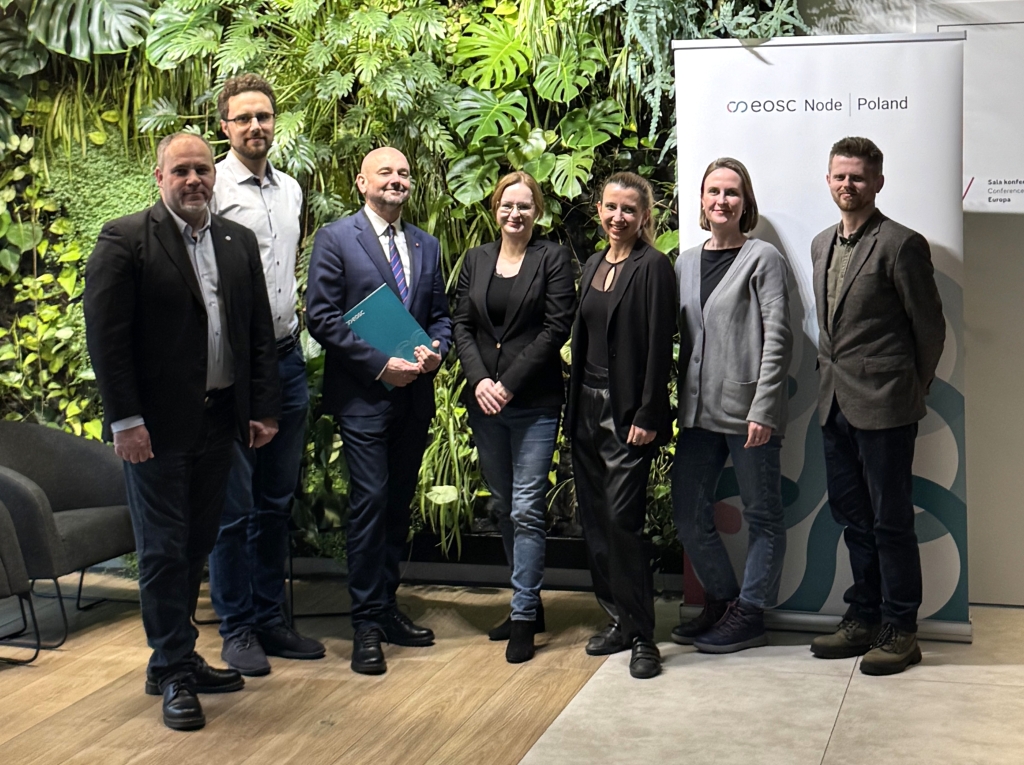 Representatives of the institutions forming EOSC Poland during the meeting formalizing the establishment of the Polish National Node of the European Open Science Cloud. From the left: Dr. Marcin Wichorowski, Institute of Oceanography of the Polish Academy of Sciences; Łukasz Opioła, ACC Cyfronet AGH; Prof. Krzysztof Jóźwiak, Director of the National Science Centre; Dr. Aneta Pazik-Aybar, NCN; Roksana Wilk, ACC Cyfronet AGH; Agnieszka Cybulska-Phelan, ICM UW; Dr. Piotr Krajewski, Gdańsk University of Technology.
More info at: https://eosc.gov.pl/en/homepage/ See also: Polish Open Science Platfrom