Publication date: January 8, 2026
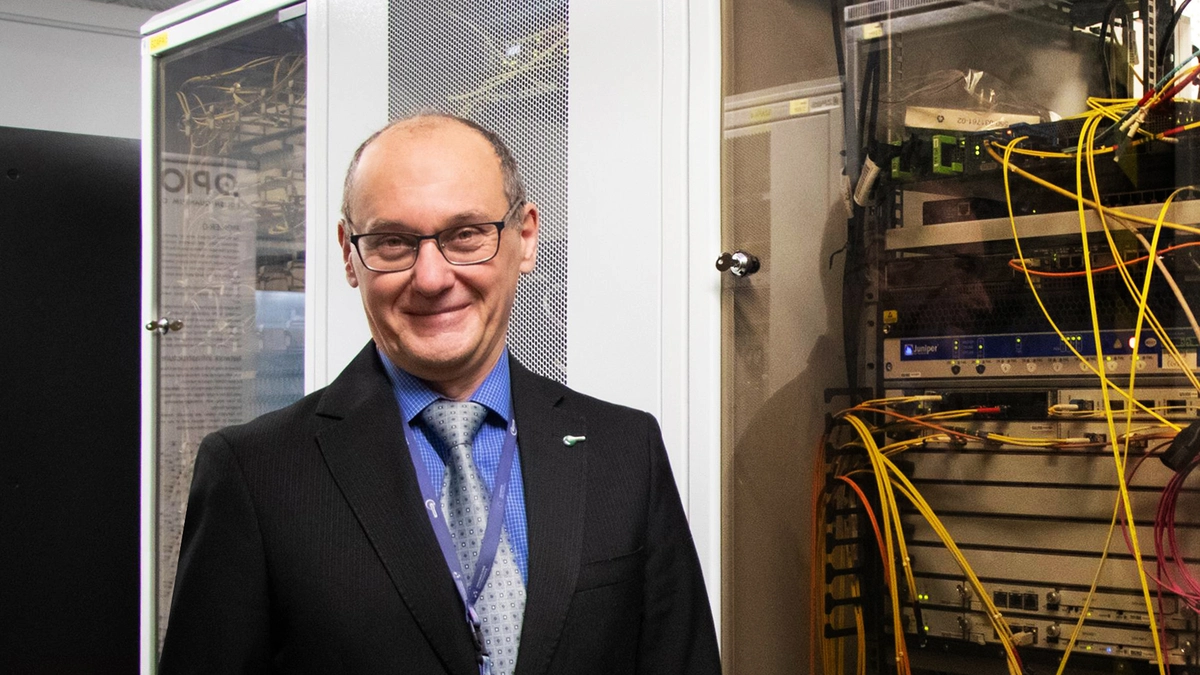
Marek Chorąży – quantum technologies specialist at the Academic Computer Centre Cyfronet AGH and lead engineer of the Quantum Key Distribution deployment, photo by E. Biśta
Due to the implementation of quantum key distribution technology by the Academic Computer Centre Cyfronet AGH, the Krakow City Hall has become the first institution connected in this way to a computing center. This is a significant step that marks the beginning of a new era of secure communication and reinforces Krakow’s position as a city dedicated to the most advanced quantum cybersecurity solutions.
Quantum protective shield for Krakow
Quantum Key Distribution technology (QKD) is one of the most advanced cryptographic technologies. It uses the laws of quantum mechanics to generate and transmit encryption keys. Its uniqueness lies in the fact that any attempt to intercept the transmission automatically destroys the key and triggers an alarm. The keys are generated in real time, eliminating the need for storage and ensuring the highest level of security.
Experts from the Academic Computer Centre Cyfronet AGH have designed, built, and launched a quantum key distribution system between the Krakow City Hall and Cyfronet AGH. This is the first connection of its kind in the region, enabling the transmission of encryption keys used to secure a 100 Gbps network link.
This enables to secure transfer of data between institutions, for purposes such as archiving, database exchange, data analysis, or enriching the information services of the Krakow City Hall
explains Karol Krawentek, Deputy Director of the Academic Computer Centre Cyfronet AGH for Data Centre Infrastructure.
Krakow’s digital shield - growing stronger
Quantum key distribution is a security technology that significantly surpasses current standards. It represents an important step toward countering potential threats posed by future quantum computers that may be capable of breaking today’s encryption methods. In this way, QKD technologies contribute to protecting Krakow’s critical infrastructure. The implementation of quantum key distribution technology is the result of cooperation between the AGH University of Krakow and the Krakow City Hall, expanding one of the core principles of Krakow’s Digital Shield: preventing cyber threats before they occur.
This is not a project for today, but an investment in Krakow’s security for decades to come. After signing the letter of intent with AGH, we said that we wanted to stay ahead of cyber threats - today, we are demonstrating that we can move from declarations to concrete, groundbreaking implementations. Quantum key distribution represents the highest possible standard of data protection, based on the laws of physics rather than on compromises. Thanks to our cooperation with AGH and Cyfronet, Krakow is building its digital security on science, innovation, and responsibility for residents’ data, while at the same time becoming an active participant in European efforts toward secure communication of the future
emphasizes Aleksander Miszalski, Mayor of Krakow.
How does it work?
Quantum key distribution technology is based on quantum secured communication between a pair of devices. On the Cyfronet side, one device generates keys using a quantum random number generator. The keys are then passed to an encryptor, which secures the connection between the Krakow City Hall and Cyfronet. On the side of the Krakow City Hall, a second device receives the keys and forwards them to a local encryptor responsible for encrypting and decrypting data within the Hall
explains Marek Chorąży, quantum technologies specialist at Cyfronet and lead engineer of the QKD system deployment.
Quantum key distribution technology is considered impossible to break. It is based on the laws of physics rather than mathematical safeguards. This means that any attempt to eavesdrop on or copy the key immediately destroys or distorts it, thereby revealing the presence of anyone trying to intercept the transmitted message or data. Unlike classical encryption, the key does not exist as an object that can be copied; instead, it is generated and transmitted in a manner governed by the principles of quantum mechanics, eliminating the possibility of interception without detection.
Part of a larger ecosystem
The data protection infrastructure developed by Cyfronet specialists further expands the unit’s services for academia and business.
To ensure the security of processed data, a QKD connection has also been established between Cyfronet’s primary and backup data centers. Given the shared use of computing resources provided by our Ares, Athena, and Helios supercomputers, as well as our storage systems, it is crucial that data transmitted between the two locations is protected with the highest possible level of security
emphasizes K. Krawentek, Deputy Director of the Academic Computer Centre Cyfronet AGH.
European infrastructure
The implementation of quantum key distribution technology in Krakow between Cyfronet and the Krakow City Hall is part of a much broader European initiative. Its goal is not to build isolated, secure connections, but to establish an extensive network spanning the entire European Union. In Poland, such links are being developed within the PIONIER-Q project, which includes connections between high-performance computing centers and selected municipal network hubs. Between 2026 and 2028, as part of the European Quantum Communication Infrastructure (EuroQCI) initiative, Cyfronet and its partners will build connections to countries located near Poland. The emerging network is designed to protect sensitive data and critical infrastructure by integrating systems based on the principles of quantum mechanics with existing communication infrastructure, providing an additional layer of security.
***
The creator of quantum key distribution is Prof. Artur Ekert, a pioneer of quantum cryptography, affiliated with the University of Oxford and the National University of Singapore. He was among the first scientists to propose using the laws of quantum mechanics to secure the transmission of information. Engineers at AGH are therefore building on a method introduced in 1991. Although quantum key distribution technology is not yet widely deployed, it continues to develop and holds strategic importance for the security of critical infrastructure, satellite communications, and data protection..