Publication date: June 5, 2026
Prof. Janiuk’s project demonstrates how critical access to world-class HPC infrastructure is for research into extreme astrophysical phenomena.
Gamma-Ray Bursts (GRBs) are the most energetic events in the Universe. Their source lies in jets ejected during the collapse of massive stars or resulting from the merger of binary systems, such as pairs of neutron stars. In a research project led by Prof. Agnieszka Janiuk from the Center for Theoretical Physics of the Polish Academy of Sciences, the power of the LUMI supercomputer was utilized to answer a fundamental question: where do heavy elements like gold, platinum, or uranium originate?
European infrastructure for demanding simulations
The main goal of the research was to conduct three-dimensional magnetohydrodynamic (GRMHD) simulations incorporating full nuclear microphysics. Prof. Janiuk’s team modeled processes occurring in accretion disks, where new elements are formed through rapid neutron capture, powering their decay in a phenomenon known as a kilonova.
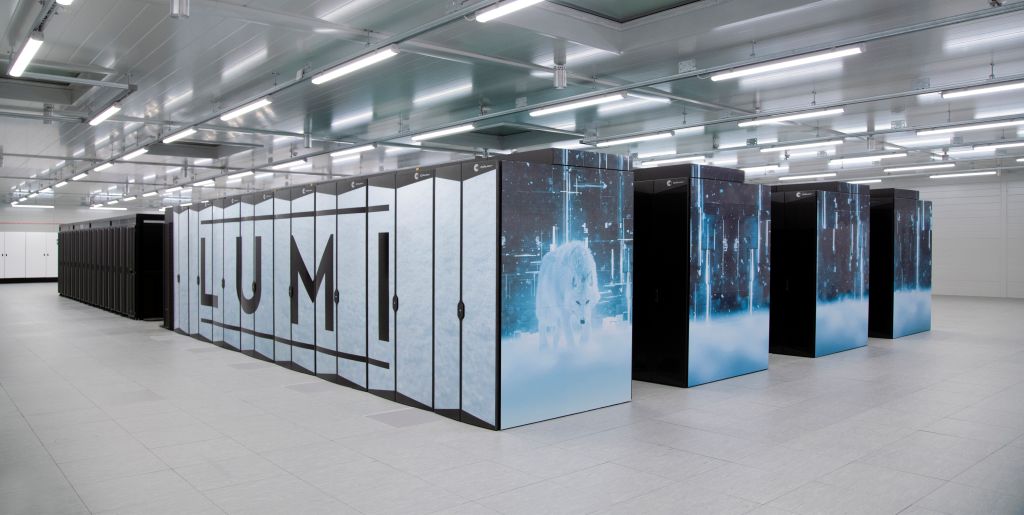
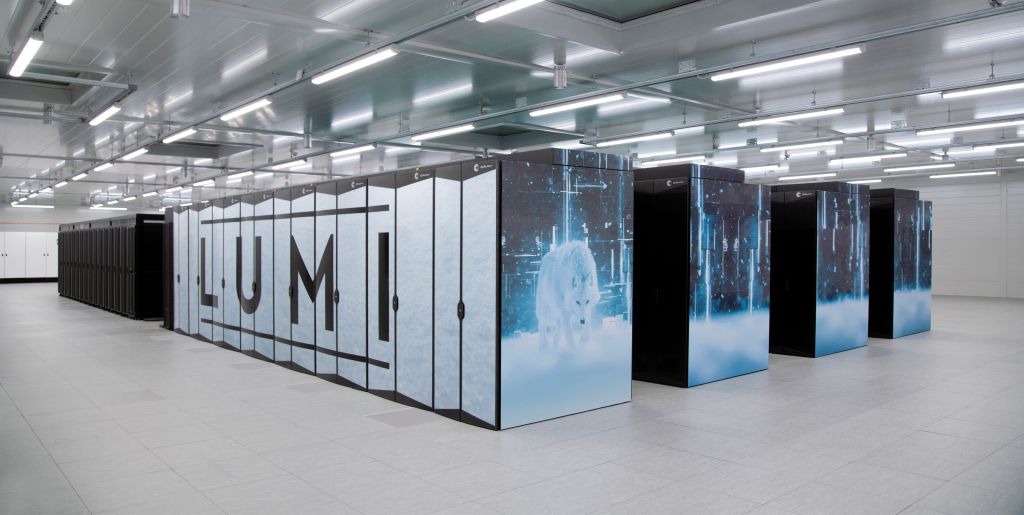
Complex physics requires enormous computational resources—millions of CPU hours. Dynamic matter ejections are studied within the code using marker particles that store data on chemical composition and velocities along the outflow trajectories. Large-scale numerical simulations require powerful hardware and operate efficiently only when a sufficiently large number of cores is available; thus, national resources in Poland were insufficient.
The utilization of European HPC infrastructure proved crucial. The system's high performance, availability of ready-to-use compilers, and efficient technical support enabled the execution of millions of CPU hours, leading to the publication of results in the journal Astronomy & Astrophysics.
Without the power of LUMI, understanding the mechanisms of enriching the Universe with heavy elements would have remained speculative. This project clearly shows that modern theoretical astrophysics requires access to world-class supercomputers.
We encourage you to read an article based on an interview with Prof. Agnieszka Janiuk, which was published on the LUMI website.
Polish researchers leveraging LUMI’s capabilities
The project led by Prof. Janiuk based on LUMI infrastructure resources was made possible thanks to Poland's participation in the consortium that financed the purchase and maintenance of the LUMI supercomputer.
Access for Polish researchers is provided through the PLGrid infrastructure based on competitions conducted by ACC Cyfronet AGH. Submitted applications undergo detailed merit-based and technical evaluation. Researchers whose projects receive approval are granted access to the LUMI supercomputer for one year. During this time, depending on the allocated resource pool, the following is available for use:
- up to 20,000,000 CPUh (computational hours on CPU cores);
- up to 1,000,000 GPUh (computational hours on GPU cores);
- up to 10,000,000 TBh (data storage resources).
To date, 47 Polish projects have been successfully completed, including 5 in the pilot phase and the rest under standard one-year access. Currently (as of June 2026), another 9 projects are underway, scheduled to complete calculations by the end of the current year. Furthermore, the results of the 10th competition for computational grants for Polish researchers on the LUMI supercomputer will be announced soon.